The Complete GDS User Researcher Training Course

We’ll walk you through everything—from understanding the Government Digital Service (GDS) and its principles, to mastering the user research lifecycle, to preparing for GDS interviews and progressing to senior roles

£3997 £6797

Save £2800

Learn the UX research skills powering the world's leading brands

About this course

Master the art of user research in government. Designed to attract aspiring and current user researchers interested in working within the UK Government Digital Service (GDS) framework
This course is your complete guide to becoming a confident, capable, and career-ready GDS User Researcher. Whether you’re transitioning from a UX background or starting fresh, you’ll gain the practical skills, insider knowledge, and strategic mindset needed to thrive in civil service roles.  

What I will learn

Understanding GDS and the Government Context

  • Explain the purpose and structure of the Government Digital Service (GDS).
  • Describe the GDS Design Principles and how they influence service design.
  • Understand the GDS Service Standard and its 14 points.
  • Identify the phases of the government service lifecycle: Discovery, Alpha, Beta, Live, and Retirement.
  • Understand the role of user research in each phase of the service lifecycle.
  • Recognise how GDS fits within the wider UK government digital transformation strategy.
  • Understand the Digital, Data and Technology (DDaT) profession framework.
  • Understand the Government Digital and Data Profession Capability Framework
  • Explain how user research supports policy development and service delivery.
  • Understand the importance of designing for everyone, including those with access needs.
  • Learn how GDS services are assessed and how user research contributes to passing assessments.Core User Research Skills in Government Jobs
  • Plan and conduct user research activities across all service phases.
  • Write clear and effective research plans aligned with GDS standards.
  • Identify appropriate research methods for different questions and contexts.
  • Recruit participants ethically and inclusively, including vulnerable and underrepresented users.
  • Design and conduct user interviews, usability testing, contextual inquiries, and surveys.
  • Apply accessibility and inclusion principles in research design and delivery.
  • Use informed consent processes and manage participant data in line with GDPR.
  • Conduct research with users who have low digital confidence or limited access.
  • Analyse qualitative data using thematic analysis and affinity mapping.
  • Synthesise findings into clear, actionable insights for delivery teams.
  • Create and maintain evidence-based user needs and personas.
  • Present research findings in a way that influences design and decision-making.
  • Use journey maps and service blueprints to communicate user experiences.
  • Document research findings in a way that supports iteration and reuse.Working in Agile Government Teams
  • Understand how user researchers contribute to agile delivery teams.
  • Collaborate effectively with service designers, content designers, developers, and product managers.
  • Participate in agile ceremonies such as sprint planning, stand-ups, and retrospectives.
  • Advocate for user needs in design critiques and prioritisation sessions.
  • Balance user needs with policy, legal, and technical constraints.
  • Work with delivery managers to plan research activities within sprint cycles.
  • Embed research into the design and development process from the start.
  • Support teams in becoming more user-centred through coaching and facilitation.GDS vs. Private Sector UX Research
  • Identify the key differences between GDS user research and private sector UX research.
  • Understand the public service ethos and its impact on research priorities.
  • Learn how policy, legislation, and accessibility standards shape design decisions.
  • Adapt private sector research skills to meet GDS expectations and constraints.
  • Understand the importance of transparency, accountability, and openness in government research.

Core User Research Skills in Government Jobs

  • Understand the user researcher career path in government (Junior, Midweight, Senior, Lead).
  • Learn what’s expected at each level, including behaviours, skills, and leadership responsibilities.
  • Build a portfolio of evidence aligned to the DDaT capability framework.
  • Develop skills in mentoring, coaching, and leading research activities.
  • Learn how to influence strategy and policy through research.
  • Understand how to contribute to research communities of practice.
  • Identify opportunities for continuous professional development within the civil service.
  • GDS Interview Preparation
  • Understand the GDS interview process, including application, task, and panel stages.
  • Prepare for behavioural questions using the STAR technique.
  • Practise answering questions aligned to DDaT capability criteria.
  • Learn how to present your research work clearly and confidently.
  • Understand what hiring managers look for in successful candidates.
  • Get tips on how to tailor your CV and application for civil service roles.
  • Tools, Templates, and Ways of Working
  • Use GDS-approved tools such as Miro, Trello, Google Workspace, and Confluence.
  • Access ready-to-use templates for research plans, consent forms, and discussion guides.
  • Learn how to document and share research in ‘Show the Thing’ sessions.
  • Understand how to work with research operations and manage logistics.
  • Learn how to embed research into service design and delivery at scale.Advanced Research Techniques and Special Topics
  • Conducting research with users who have accessibility needs, including screen reader users and those with cognitive impairments
  • Running remote user research using tools like Zoom, Lookback, or Microsoft Teams
  • Designing inclusive research for users with low literacy or English as a second language
  • Using quantitative methods in government research (e.g. surveys, analytics)
  • Working with behavioural insights and nudging techniques in public services
  • Conducting research in sensitive or high-risk policy areas (e.g. justice, health, immigration)
  • Researching internal users (e.g. civil servants, caseworkers, operational staff)
  • Working with interpreters and translators in multilingual research
  • Designing research for assisted digital users and non-digital journeys
  • Using co-design and participatory research methods with

Research Operations and Governance

  • Setting up and managing participant recruitment pipelines
  • Working with third-party recruitment agencies and research suppliers
  • Managing incentives and participant payments in line with government policy
  • Creating and maintaining research repositories and evidence libraries
  • Writing research ethics statements and risk assessments
    Ensuring compliance with data protection, safeguarding, and consent policies
  • Working with legal and information governance teamsCommunication and Influence
  • Writing compelling research reports for senior stakeholders
  • Creating visual artefacts to communicate findings (e.g. personas, journey maps, service blueprints)
  • Facilitating workshops and playback sessions with delivery teams
  • Influencing product and policy decisions through evidence
  • Handling pushback or resistance to research findings
  • Building trust with stakeholders and users
  • Communicating uncertainty and limitations in researchCommunity, Culture, and Continuous Improvement
  • Contributing to user research communities of practice
  • Sharing research findings across departments and services
  • Participating in cross-government research initiatives
  • Staying up to date with GDS updates, blogs, and guidance
  • Reflecting on your practice and using feedback to improve
  • Supporting diversity, equity, and inclusion in research and hiring
  • Building a personal development plan as a user researcher
  • Understanding the role of ethics and public value in government research
  • GDS Interview Preparation – From Junior to Senior User Researcher
  • 
This module prepares learners for applying to and succeeding in GDS-aligned user researcher roles, from junior to
  • senior levels. It includes detailed guidance on the application process, interview structure, and how to demonstrate capability using the DDaT frameworkTopics Covered:
  • Understanding the DDaT capability framework and role expectations
  • The GDS-aligned recruitment process: application, task, and panel interview
  • How to write a strong CV and personal statement for civil service roles
  • How to structure answers using the STAR (Situation, Task, Action, Result) method
    Common interview questions for:
  • Junior User Researcher
  • Midweight User Researcher
  • Senior User Researcher
  • Example answers and what good looks like
  • How to talk about research impact and influence
  • Demonstrating leadership and strategic thinking at senior levels
  • Preparing for technical tasks or case studies
  • Tips for virtual interviews and panel dynamics
  • How to follow up after interviews and request feedback

Understanding success profiles and civil service behavioursHow to Get Your First Job as a GDS User Researcher

Overview:
This module is designed to help aspiring user researchers break into the UK government or public sector for the first time. It covers everything from identifying suitable roles to building a competitive application and preparing for interviews.
Topics Covered:

  • Understanding entry points into government user research roles (e.g. Junior UR, Associate UR, internships, apprenticeships)
  • Where to find GDS-aligned job listings (e.g. Civil Service Jobs, Contracts Finder, LinkedIn, digital agencies)
  • How to read and interpret civil service job descriptions and DDaT role profiles
    Building a CV tailored to government user research roles
  • Writing a compelling personal statement that aligns with the GDS mission and values
  • Highlighting transferable skills from other roles (e.g. UX, academia, customer research, social research)
  • Creating a portfolio or case studies that demonstrate research thinking and impact
  • How to gain experience before applying (e.g. volunteering, shadowing, side projects, mentoring)
  • Building a network in the public sector (e.g. attending cross-government meetups, joining Slack groups, following GDS blogs)
  • Understanding the civil service recruitment process and timelines
  • How to apply for fixed-term, permanent, and contract roles
  • Tips for standing out in a competitive field
  • Common mistakes to avoid when applying for your first role
  • How to handle rejections and use feedback to improve

What are the requirements?

  • A basic understanding of user-centred design or UX principles.
  • Some experience working in digital teams or with users.
  • A willingness to learn about public sector processes and constraints.

What resources and materials will I get?

  • Lessons and walkthroughs of real GDS projects.
  • Templates and toolkits for research plans, consent forms, discussion guides, and analysis frameworks.
  • Practice exercises and mock interview scenarios.
  • Case studies from real government services.
  •  Career roadmap to help you progress from Junior to Senior User Researcher.

Who is this course designed for?

  • Aspiring user researchers looking to break into UK government roles.
  • Anyone interested in the government design system and UX project ways of working
  • UX professionals transitioning into the public sector and local government.
  • Junior UX researchers aiming to level up to midweight or senior roles.
  • Contractors and freelancers working with government civil service clients.
  • Civil servants in digital teams who want to better understand user research

£3997 £6797

Save £2800

📬 Full course address, itinerary, and all the details will be sent straight to your inbox shortly.

💬 Got questions? Feel free to WhatsApp us via the link on our homepage or drop us an email at hello@1ux1.co.uk – we’re happy to help!

Our current course locations

Worldwide - Live online

London

The Charter Building, Charter Place, Uxbridge UB8 1JG

London

The Charter Building, Charter Place, Uxbridge UB8 1JG

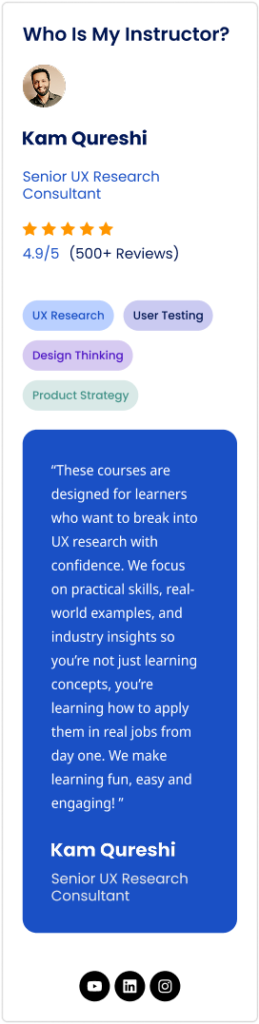
Who Is My Instructor?

Kam Qureshi

Senior UX Research Consultant

4.9/5

(500+ Reviews)

“These courses are designed for learners who want to break into UX research with confidence. We focus on practical skills, real-world examples, and industry insights so you’re not just learning concepts, you’re learning how to apply them in real jobs from day one. We make learning fun, easy and engaging! ”


Senior UX Research Consultant

See All Courses

Certified

Professional

UX Researcher Courses

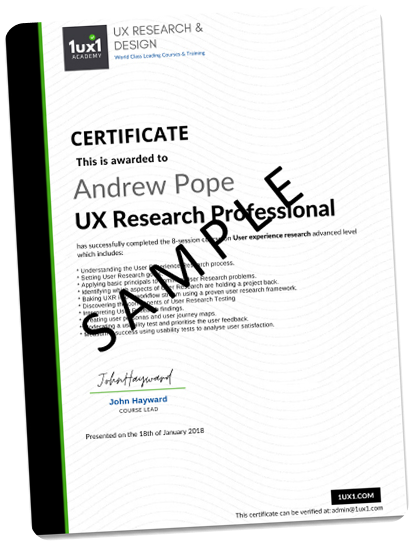
Upon completing a minimum of four courses of your choice, you will receive your UX research professional or UX designer professional certificate.

Our 1UX1 Academy accredited certificate will :

Our Courses

Offer

:

We are certain our courses will meet your expectations